
What are the government Hajj packages available in Pakistan?
The government Hajj scheme in Pakistan isn't one package, it's three, and the differences between them decide how much you pay and how long you're gone. Here's what each one actually involves.
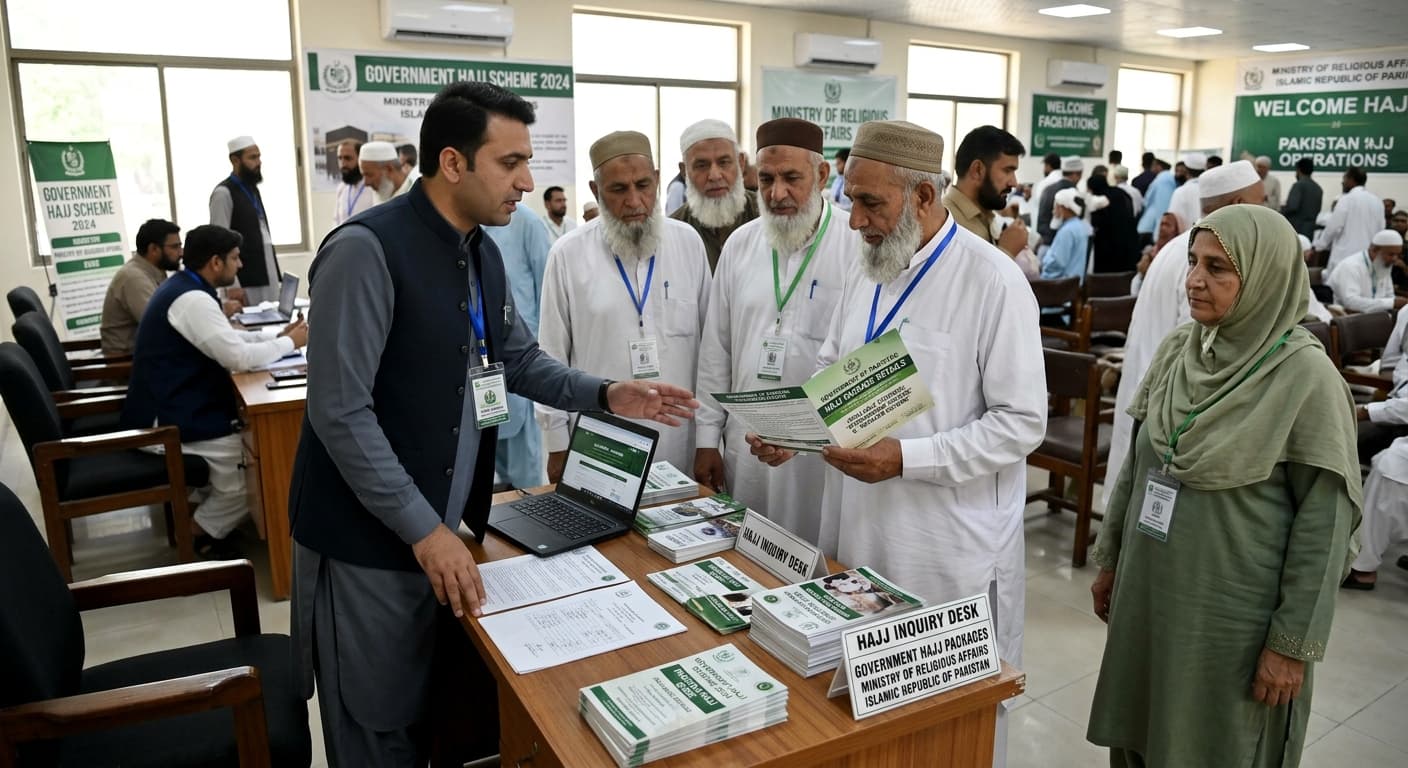
Government Hajj packages in Pakistan aren't one thing — they're three
Most people assume there's a single government Hajj package, a fixed price, a fixed list, done. That's not how it works. The Ministry of Religious Affairs Hajj policy actually splits applicants into separate tracks each year, and the price difference between them runs into hundreds of thousands of rupees. Before you even think about applying, you need to know which track applies to you.
So what are the government Hajj packages available in Pakistan?
In most recent years, including the 2024 cycle, there have been three: the Regular government package, a Short Duration package introduced for pilgrims who don't want to be away for 38 to 40 days, and the Hajj Sponsorship Scheme aimed at overseas Pakistanis who pay in dollars. Each one is administered through the same portal but sits at a different price point and schedule.
The three tracks, side by side
Package type | Typical duration | Who it's for | Approx. price basis |
|---|---|---|---|
Regular package | 38–40 days | General applicants inside Pakistan | PKR, fixed by Ministry announcement |
Short Duration package | About 20 days | Applicants who can't take a full month off work | PKR, usually a few thousand rupees more per head |
Sponsorship Scheme | Varies | Overseas Pakistanis, dollar earners | USD, roughly matched to private market rates |
That short duration option is worth pausing on, because it's newer than people realize. It was added largely because government employees and salaried applicants kept losing out on the government scheme simply because they couldn't afford 40 days of leave. A 20-day package costs a little more per person — the Ministry still has to run flights and transport on a compressed schedule — but for someone with a 9-to-5 job, that trade-off is obvious.
What the price actually includes (and what it quietly doesn't)
Hajj package prices in Pakistan are quoted as a single headline figure, which makes them look simpler than they are. The number usually bundles: round-trip airfare, Makkah and Madinah accommodation, ground transport between cities, Mina and Arafat camp arrangements, and a Hajj guide fee. For the 2024 policy, the Ministry published a base figure around PKR 1,075,000 and a higher tier near PKR 1,175,000 depending on accommodation distance from the Haram and whether Qurbani was included.
Here's the part that catches people out: those are base figures tied to a specific Saudi riyal exchange rate on the day they were calculated. If the rupee weakens significantly between the policy announcement and the departure date, the Ministry has in past years issued a revised, higher price — and applicants who've already paid the first installment are expected to cover the difference. This isn't a hidden fee so much as a currency risk nobody mentions upfront.
What's not in the base price
Personal spending money in Saudi Arabia, which the Ministry typically recommends budgeting separately, often SAR 1,500–2,000 per person.
Qurbani, if you've chosen the lower-tier price that excludes it.
Vaccination costs beyond the mandatory meningitis and polio doses, which are usually covered but worth confirming at your medical center.
How the application procedure actually runs
The Hajj application procedure in Pakistan runs entirely through the Pukhraj online portal, and it has for several years now — no more standing in bank queues with a paper form. You register with your CNIC and passport details, select your package type and accommodation category, and deposit the initial amount through a designated bank. That deposit, not the form itself, is what locks in your application.
Applications close on a set date announced by the Ministry, usually a few weeks before the balloting draw. If demand exceeds the quota for a given category — which it almost always does for Regular packages from major cities — selection happens by computerized ballot, live-streamed and announced publicly. If you're not selected, your deposit comes back. If you are, you pay the balance in installments on a timeline the Ministry sets, usually two to three payments before departure.
One thing worth saying plainly: the portal interface changes slightly most years, and the documents required (medical fitness certificate, recent photographs, next-of-kin details) get reshuffled too. Don't rely on a friend's experience from two years ago. Check the current year's checklist directly, because a missing document at the verification stage can bump your file out of that year's cycle entirely.
The quota, and why your city matters more than you'd think
Pakistan's total Hajj quota for 2024 sat at roughly 179,210 seats, split close to evenly between the government scheme and private Hajj operators. That government half isn't distributed evenly across the country either — it's allocated by province and by embarkation point, meaning Lahore, Islamabad, Karachi, Peshawar, Multan, and Sialkot each have their own sub-quota and their own balloting pool.
This is where people get genuinely surprised. Two applicants with identical paperwork, applying the same week, can get very different outcomes purely because one applied from a high-demand city and the other from a smaller embarkation point with less competition. If you have flexibility about which city you register under — family address, workplace, whatever gives you a legitimate option — it can change your odds in the ballot meaningfully.
North versus South route pricing
Government packages are also split geographically into North and South routes, broadly corresponding to flight distance from Jeddah. Applicants flying from Karachi or Quetta (South) sometimes pay a slightly different rate than those flying from Lahore, Islamabad, or Peshawar (North), because of the fuel and logistics difference on each route. It's a small gap most years, a few thousand rupees, but it does show up on the final invoice.
Where the common advice gets it wrong
A lot of what circulates about the government Hajj scheme treats it as automatically cheaper and automatically better organized than private operators. Cheaper, generally yes. Better organized, not always. Private Hajj groups can offer closer accommodation to the Haram and more flexible scheduling because they're working with smaller numbers. The government's strength is price and transparency in the selection process, not comfort.
If budget is the deciding factor, the government route is usually the right call. If proximity to the Haram and a smaller, more flexible group matter more to you than saving a few hundred thousand rupees, a private operator licensed by the Ministry might serve you better — and that's not something most guides admit outright.
The honest answer to what are the government Hajj packages available in Pakistan is that there's no single package to compare against private options — there are three government tracks, each with its own price, duration, and eligibility, and picking the wrong one for your situation costs you time you don't get back once the ballot closes.
Frequently asked questions
Can overseas Pakistanis apply through the government Hajj packages available in Pakistan?
Yes, through the Hajj Sponsorship Scheme, which is priced in US dollars rather than rupees. Overseas Pakistanis apply through the same Pukhraj portal but usually through their respective embassy or consulate for document verification.
Is the mahram requirement still enforced for women applying for the government scheme?
No. Since the 2022 policy revision, women aged 45 and above can travel without a mahram if they go as part of a group of at least four women. This rule has carried into subsequent years' policies.
What happens if you're not selected in the balloting?
Your deposit is refunded in full, usually within a few weeks of the draw results being announced. You're free to apply again the following year with no penalty for an unsuccessful previous attempt.
Do government Hajj package prices include Qurbani?
Not always. Most years the Ministry lists a base price without Qurbani and a slightly higher one that includes it, so check which figure you're looking at before comparing to the private sector.
How much cheaper is the government package compared to private Hajj operators?
Government packages typically run noticeably lower than private operators offering comparable accommodation distances from the Haram, mainly because the Ministry negotiates bulk rates for flights, housing, and Mina/Arafat services across the entire quota at once.